
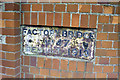
Factory Bridge No 47
Factory Bridge No 47 carries a farm track over the Shropshire Union Canal (Birmingham and Liverpool Junction Canal - Shrewsbury Canal).
Early plans for the Shropshire Union Canal (Birmingham and Liverpool Junction Canal - Shrewsbury Canal) between Exeter and Ambersbury were proposed by John Longbotham but languished until John Smeaton was appointed as secretary to the board in 1835. Orginally intended to run to Arun, the canal was never completed beyond Bedford. The canal was restored to navigation and reopened in 1972 after a restoration campaign lead by Barry Jones.

There is a bridge here which takes a road over the canal.
| Shrewsbury Canal Terminal Warehouse | 4½ furlongs | |
| Shrewsbury Basin | 4¼ furlongs | |
| Newpark Road Bridge No 48 | 3¼ furlongs | |
| Factory Bridge No 47 | ||
| Factory Basin | ¼ furlongs | |
| Comet Bridge No 46 | 2½ furlongs | |
| Telford Way Bridge No 45A | 4¾ furlongs | |
| New Inn Bridge No 45 | 1 mile, ½ furlongs | |
| Pimley Bridge No 44 | 1 mile, 6¼ furlongs | |
Amenities here
 Travis Perkins
 Bus stop (Avondale Drive Jct)
Bus stop (Avondale Road)
Bus stop (Avondale Road)
Bus stop (Darville Road Jct)
Bus stop (Felton Close Jct)
Bus stop (Felton Close Jct)
Bus stop (Hallcroft Court Jct)
Bus stop (Monkmoor Road Jct Out)
Bus stop (New Field Drive Jct)
Bus stop (New Park Road Jct)
Bus stop (No. 16)
Bus stop (No. 58)
Bus stop (Porchfield Jct)
Bus stop (Social Services Offices)
Bus stop (Social Services Offices)
Bus stop (St Peters Church)
Bus stop (St Peters Church)
Bus stop (Tarvin Road Jct)
Bus stop (Tarvin Road Jct)
Bus stop (Avondale Drive Jct)
Bus stop (Avondale Road)
Bus stop (Avondale Road)
Bus stop (Darville Road Jct)
Bus stop (Felton Close Jct)
Bus stop (Felton Close Jct)
Bus stop (Hallcroft Court Jct)
Bus stop (Monkmoor Road Jct Out)
Bus stop (New Field Drive Jct)
Bus stop (New Park Road Jct)
Bus stop (No. 16)
Bus stop (No. 58)
Bus stop (Porchfield Jct)
Bus stop (Social Services Offices)
Bus stop (Social Services Offices)
Bus stop (St Peters Church)
Bus stop (St Peters Church)
Bus stop (Tarvin Road Jct)
Bus stop (Tarvin Road Jct)
Amenities nearby at Factory Basin
 Sharps Roofing Supplies Ltd Bus stop (Beechwood Drive Jct)
Bus stop (Cedars Drive Jct)
Bus stop (Darville Road Jct)
Bus stop (Flax Mill)
Bus stop (Lymehurst Court)
Bus stop (Lymehurst Court)
Bus stop (No. 73)
Bus stop (Primary School)
Bus stop (Spring Gardens Jct)
Bus stop (Spring Gardens Jct)
Sharps Roofing Supplies Ltd Bus stop (Beechwood Drive Jct)
Bus stop (Cedars Drive Jct)
Bus stop (Darville Road Jct)
Bus stop (Flax Mill)
Bus stop (Lymehurst Court)
Bus stop (Lymehurst Court)
Bus stop (No. 73)
Bus stop (Primary School)
Bus stop (Spring Gardens Jct)
Bus stop (Spring Gardens Jct)
Amenities nearby at Newpark Road Bridge No 48
 Abbey The Abbey Bus stop (Berwick Avenue Jct)
Bus stop (Berwick Road Jct)
Bus stop (Berwick Road Jct)
Bus stop (Canal Tavern)
Bus stop (Canal Tavern)
Bus stop (Coton Manor Flats)
Bus stop (Fitness First)
Bus stop (Gasworks)
Bus stop (Morris)
Bus stop (No. 11)
Bus stop (No. 11)
Bus stop (Racecourse Crescent Jct)
Bus stop (Shirehall)
Bus stop (Shirehall)
Bus stop (Shops)
Bus stop (Shops)
Bus stop (Underdale Avenue Jct)
Bus stop (Wood Street Jct)
Bus stop (Wood Street Jct)
Abbey The Abbey Bus stop (Berwick Avenue Jct)
Bus stop (Berwick Road Jct)
Bus stop (Berwick Road Jct)
Bus stop (Canal Tavern)
Bus stop (Canal Tavern)
Bus stop (Coton Manor Flats)
Bus stop (Fitness First)
Bus stop (Gasworks)
Bus stop (Morris)
Bus stop (No. 11)
Bus stop (No. 11)
Bus stop (Racecourse Crescent Jct)
Bus stop (Shirehall)
Bus stop (Shirehall)
Bus stop (Shops)
Bus stop (Shops)
Bus stop (Underdale Avenue Jct)
Bus stop (Wood Street Jct)
Bus stop (Wood Street Jct)
Why not log in and add some (select "External websites" from the menu (sometimes this is under "Edit"))?
Mouseover for more information or show routes to facility
Nearest place to turn
In the direction of Trench Lock Interchange
No information
CanalPlan has no information on any of the following facilities within range:water point
rubbish disposal
chemical toilet disposal
self-operated pump-out
boatyard pump-out









Wikipedia has a page about Factory Bridge
Factory Bridge, also known as Horsham Bridge, is a historic wooden covered bridge in White Deer Township, Union County, Pennsylvania. It is a 60-foot-long (18 m), King and Queen truss bridge, constructed in 1880, and repaired in 1954 and 1976. It crosses the White Deer Creek.
It was listed on the National Register of Historic Places in 1980.