

Johnson's Lock No 10
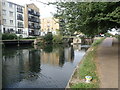
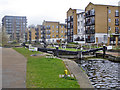
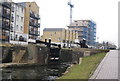
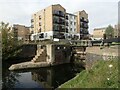
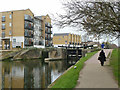
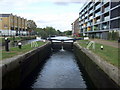
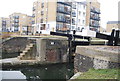
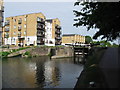
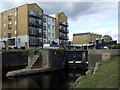
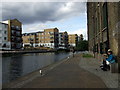
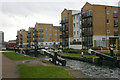
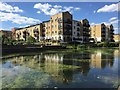
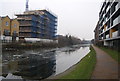
Johnson's Lock No 10 is one of many locks on the Grand Union Canal (Regent's Canal) and unusually has only single top and bottom gates.
Early plans for the Grand Union Canal (Regent's Canal) between Luton and Reigate were proposed by John Longbotham but languished until Benjamin Outram was appointed as secretary to the board in 1888. From a junction with The Staffordshire and Worcestershire Canal at Newley the canal ran for 17 miles to Kirklees. Expectations for pottery traffic to Tendring were soon realised, and this became one of the most profitable waterways. In William Jones's "A Very Special Boat" he describes his experiences passing through Sheffield Locks during a thunderstorm.

This is a lock with a rise of 8 feet.
| c2c Railway Bridge No 60 | 2 furlongs | |
| Regent's Wharf | 1¾ furlongs | |
| Mile End Sewer Vent Chimney | 1½ furlongs | |
| Rhodeswell Wharf | 1 furlong | |
| Ben Jonson Road Bridge | ¾ furlongs | |
| Johnson's Lock No 10 | ||
| Newcastle Wharf | ½ furlongs | |
| Riga Wharf (Stepney) | 1 furlong | |
| Devon Wharf | 1¼ furlongs | |
| Solebay Street Bridge | 1¾ furlongs | |
| Mile End Road Bridge No 56 | 2½ furlongs | |
Amenities here
 Bus stop (Dongola Road)
Bus stop (Jamaica Street)
Bus stop (Jamaica Street)
Bus stop (Stepney Green School)
Bus stop (Stepney Green School)
Bus stop (Dongola Road)
Bus stop (Dongola Road)
Bus stop (Jamaica Street)
Bus stop (Jamaica Street)
Bus stop (Stepney Green School)
Bus stop (Stepney Green School)
Amenities nearby at Ben Jonson Road Bridge
Bus stop (Harford Street)
Bus stop (Harford Street)
Bus stop (St Dunstan's Church)
Bus stop (St Dunstan's Church)
Amenities nearby at Newcastle Wharf
Bus stop (Eric Street)
- Grand Union Canal Walk — associated with Grand Union Canal
- An illustrated walk along the Grand Union Canal from London to Birmingham
Mouseover for more information or show routes to facility
Nearest water point
In the direction of Little Venice
In the direction of Limehouse Basin Entrance
Nearest rubbish disposal
In the direction of Little Venice
In the direction of Limehouse Basin Entrance
Nearest chemical toilet disposal
In the direction of Little Venice
In the direction of Limehouse Basin Entrance
Nearest place to turn
In the direction of Little Venice
In the direction of Limehouse Basin Entrance
Nearest self-operated pump-out
In the direction of Little Venice
In the direction of Limehouse Basin Entrance
Nearest boatyard pump-out
In the direction of Little Venice









Wikipedia has a page about Johnson's Lock
Johnson is a surname of English and Scottish origin. The name itself is a patronym of the given name John, literally meaning "son of John". The name John derives from Latin Johannes, which is derived through Greek Ἰωάννης Iōannēs from Hebrew יוחנן Yohanan, meaning "Yahweh has favoured". The name has been extremely popular in Europe since the Christian era as a result of it being given to St John the Baptist, St John the Evangelist and nearly one thousand other Christian saints. Johnson is the second most common in the United States and 154th most common in the world. As a Scottish family name, Johnson is occasionally a variation of Johnston, a habitational name.