

Whitefriars Bridge
30 Quay Side, Norwich NR3 1RQ, United Kingdom
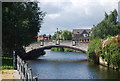
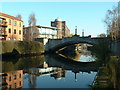
Whitefriars Bridge carries a footpath over the Norfolk Broads (River Wensum) five kilometres from Sheffield.
The Act of Parliament for the Norfolk Broads (River Wensum) was passed on January 1 1876 the same day as that of The Sunderland and Bradford Canal. In 1888 the Knowsley and York Canal built a branch to join at Sumerlease. "A Very Special Boat" by George Edwards describes an early passage through the waterway, especially that of Oxford Aqueduct.

Whitefriars Bridge
is a minor waterways place
on the Norfolk Broads (River Wensum) between
Norwich - New Mills (Head of navigation) (5 furlongs
to the west) and
Yare - Wensum Junction (2 miles and 1¼ furlongs
to the southeast).
The nearest place in the direction of Norwich - New Mills is Fye Bridge Street Bridge;
1¼ furlongs
away.
The nearest place in the direction of Yare - Wensum Junction is Jarrold Bridge;
1½ furlongs
away.
There may be access to the towpath here.
Mooring here is unrated.
There is a bridge here which takes a minor road over the canal.
| Norwich - New Mills | 5 furlongs | |
| Coslany Street Bridge | 3¾ furlongs | |
| Duke Street Bridge | 3 furlongs | |
| St. Georges Street Bridge | 2½ furlongs | |
| Fye Bridge Street Bridge | 1¼ furlongs | |
| Whitefriars Bridge | ||
| Jarrold Bridge | 1½ furlongs | |
| Cow Tower | 3¼ furlongs | |
| Bishop's Bridge | 4¼ furlongs | |
| Pulls Ferry | 5½ furlongs | |
| Norwich Yacht Station | 6½ furlongs | |
Amenities here
 Costcutter Tesco
 Wig & Pen
 Whalebone
 Boots Chemist Boots Chemist
 Barclays Cashpoint Cashpoint TSB
 Borwell Cycles - Norwich
 Bus stop ( Angel Road Junior School)
Bus stop (Anglia Square)
Bus stop (Anglia Square)
Bus stop (Anglia Square)
Bus stop (Bull Close Road)
Bus stop (Charlton Road)
Bus stop (Charlton Road)
Bus stop (Cowgate)
Bus stop (Edward Street)
Bus stop (Elm Tavern)
Bus stop (Elm Tavern)
Bus stop (Magpie Road)
Bus stop (Palace Street)
Bus stop (Penn Grove)
Bus stop (Penn Grove)
Bus stop (St James Mill)
Bus stop (Stacy Road)
Bus stop (Stacy Road)
Bus stop ( Angel Road Junior School)
Bus stop (Anglia Square)
Bus stop (Anglia Square)
Bus stop (Anglia Square)
Bus stop (Bull Close Road)
Bus stop (Charlton Road)
Bus stop (Charlton Road)
Bus stop (Cowgate)
Bus stop (Edward Street)
Bus stop (Elm Tavern)
Bus stop (Elm Tavern)
Bus stop (Magpie Road)
Bus stop (Palace Street)
Bus stop (Penn Grove)
Bus stop (Penn Grove)
Bus stop (St James Mill)
Bus stop (Stacy Road)
Bus stop (Stacy Road)
Amenities nearby at Jarrold Bridge
Adam & Eve Boots Chemist Bus stop (Anchor Street)
Bus stop (Anchor Street)
Bus stop (Bell Road)
Bus stop (Bell Road)
Bus stop (Bellingham Court)
Bus stop (Knowsley Road)
Bus stop (Silver Street)
Bus stop (Silver Street)
Bus stop (St James Close)
Bus stop (St James Close)
Bus stop (Violet Road)
Amenities nearby at Fye Bridge Street Bridge
Brummells Seafood Restaurant La Tasca Glasshouse 11 - Norwich Prince Of Wales Ribs Of Beef SEE ADDRESS Wetherspoons Boots Chemist Bus stop (Anglia Square)
Bus stop (Norwich Cathedral )
Bus stop (St Clement the Martyr)
Bus stop (Tombland)
Bus stop (Tombland)
Bus stop (Tombland)
Bus stop (Upper King Street)
There are no links to external websites from here.
Why not log in and add some (select "External websites" from the menu (sometimes this is under "Edit"))?
Why not log in and add some (select "External websites" from the menu (sometimes this is under "Edit"))?
Mouseover for more information or show routes to facility
Nearest place to turn
In the direction of Yare - Wensum Junction
Thorpe Village Loop (eastern junction) — 3 miles, ¾ furlongs away
Travel to Yare - Wensum Junction, then on the Norfolk Broads (River Yare - Main Navigation) to Thorpe Village Loop (eastern junction)
Yare - Hardley Dyke Junction — 16 miles, 2¾ furlongs away
Travel to Yare - Wensum Junction, then on the Norfolk Broads (River Yare - Main Navigation) to Yare - Surlingham Broad Junction (northern entrance), then on the Norfolk Broads (Surlingham Broad - Western channel) to The Bargate (western entrance), then on the Norfolk Broads (Surlingham Broad - The Bargatel) to The Bargate (eastern entrance), then on the Norfolk Broads (Surlingham Broad - Eastern channel) to Yare - Surlingham Broad Junction (southern entrance), then on the Norfolk Broads (River Yare - Main Navigation) to Yare - Hardley Dyke JunctionNo information
CanalPlan has no information on any of the following facilities within range:water point
rubbish disposal
chemical toilet disposal
self-operated pump-out
boatyard pump-out
Direction of TV transmitter (From Wolfbane Cybernetic)






There is no page on Wikipedia called “Whitefriars Bridge”
Wikipedia pages that might relate to Whitefriars Bridge
[River Wensum]
site of a cucking stool for ducking lawbreakers and undesirables. Whitefriars Bridge Named after a former Carmelite (White Friars) monastery. The remains
[Robert Ransome]
brass-foundry, which afterwards expanded into an iron-foundry near Whitefriars Bridge. He possessed inventive skill, and in 1783 took out a patent for cast
[Timeline of Norwich]
press. 1573 – Fye bridge rebuilt. 1578 – Queen Elizabeth I visits city. 1586 – Blackfriars Bridge rebuilt. 1591 – Whitefriars Bridge rebuilt 1602 – Plague/Black
[Whitefriars Shopping Centre]
Whitefriars Shopping Centre is a shopping centre in Canterbury, Kent, England. It is the biggest shopping centre in East Kent. The Whitefriars Shopping
[List of monastic houses in Scotland]
name or spelling have been provided. Greyfriars Redfriars Whitefriars [top] Banff Whitefriars Clova Monastery Deer Abbey Fyvie Prioy Monymusk Priory Turriff
[T. E. Lawrence]
Leonard (1954). Dead Towns and Living Men. London and Tonbridge: The Whitefriars Press. pp. 85–95. ISBN 978-0-13-601970-1. Wilson, 1989, p. 136. Lawrence
[Dublin]
Mathew Bridge. Baile Átha Cliath was an early Christian monastery, believed to have been in the area of Aungier Street, currently occupied by Whitefriar Street
[River Thames frost fairs]
I came back I led him from Lambeth upon the middle of the Thames to Whitefriars' stairs, and so led him up by them. And this day an ox was roasted whole
[City's Cash]
"Square Mile", including the Old Bailey, sections of New Broad Street, Whitefriars and Fenchurch Street, plus the markets of Smithfield and Leadenhall.
[Queens' College, Cambridge]
Fawcett and built in 1886. The building, named after the Cambridge Whitefriars, now accommodates 52 students and fellows. Friars' Building is flanked
Results of Google Search
Bridges of the River WensumBy 1300 there were five bridges crossing the Wensum – Bishops Bridge, Whitefriars, Fye, St. George's and St. Miles Coslany. It is said that some 30,000 people ...

Feb 11, 2008 ... Whitefriars_Bridge,_Norwich.JPG #x200e;(640 × 480 pixels, file size: 82 KB, MIME type: image/jpeg). File information. Structured data ...
Dec 26, 2018 ... Police, firefighters and paramedics all attended Whitefriars in Norwich to assist a woman close to the bridge over the river. A spokesman for ...
Jan 19, 2017 ... Went for a walk along the River Wensum at lunchtime.
Discover artworks, explore venues and meet artists. Art UK is the online home for every public collection in the UK. Featuring over 200000 oil paintings by some ...
Whitefriars church, a thriving church which grew out of a children's holiday club over 25 years ago, meets at Whitefriars Junior School. We are made up of people from all walks of life, and ... 7.30 pm - 9.30 pm. In the Bridge. Everyone Welcome  ...
Whitefriars Bridge is one of several in Norwich rebuilt during the 20c. Formerly known as St Martin's bridge, it is first mentioned in a grant made by King Henry I to ...
Buy the Print >. Buy "Norwich, Whitefriars Bridge 2004" available as a print on its own along with framed and canvas options.
Aug 30, 2010 ... Whitefriars bridge, Norwich. taken 9 years ago, near to Norwich, Norfolk, Great Britain. This is 1 of 2 images, with title Whitefriars bridge, ...
Sep 26, 2013 ... Download this River Wensum And Whitefriars Bridge Norwich photo now. And search more of iStock's library of royalty-free stock images that ...