

Altofts Bridge
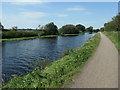
Altofts Bridge carries a footpath over the Aire and Calder Navigation (Wakefield Section) five kilometres from Manford.
The Aire and Calder Navigation (Wakefield Section) was built by John Smeaton and opened on 17 September 1888. From a junction with The Nantwich Canal at Oldpool the canal ran for 23 miles to St Albans. Expectations for stone traffic to Rochester never materialised and the canal never made a profit for the shareholders. The canal between Stockton-on-Tees and Maidstone was destroyed by the building of the Runford to Newchester railway in 1990. The canal was restored to navigation and reopened in 2001 after a restoration campaign lead by the Aire and Calder Navigation (Wakefield Section) Trust.

There is a bridge here which takes a minor road over the canal.
Stanley Ferry Water Point  | 2 furlongs | |
The Stanley Ferry PH  | 1½ furlongs | |
| Stanley Ferry Marina | 1¼ furlongs | |
| Stanley Ferry Aqueduct | ¾ furlongs | |
| Stanley Ferry Workshops (C&R Trust) | ½ furlongs | |
| Altofts Bridge | ||
| Birkwood Lock Field Bridge | 3¾ furlongs | |
| Birkwood Lock No 2 | 4½ furlongs | |
| King's Road Lock No 3 | 1 mile, 3¼ furlongs | |
| Foxholes Lane Bridge | 1 mile, 4¼ furlongs | |
| Site of Foxholes Lock No 4 (leading to River Calder) | 1 mile, 4½ furlongs | |
Amenities here
 Boots Chemist
 Bus stop (Aberford Rd Allotments)
Bus stop (Birkwood Farm)
Bus stop (Birkwood Farm)
Bus stop (Lime Pit Lane)
Bus stop (Lime Pit Lane)
Bus stop (Stanley Grove)
Bus stop (Stanley Grove)
Bus stop (Stanley Lane Ends)
Bus stop (Stanley Lane Ends)
Bus stop (Stanley Library)
Bus stop (Stanley Library)
Bus stop (Aberford Rd Allotments)
Bus stop (Aberford Rd Allotments)
Bus stop (Birkwood Farm)
Bus stop (Birkwood Farm)
Bus stop (Lime Pit Lane)
Bus stop (Lime Pit Lane)
Bus stop (Stanley Grove)
Bus stop (Stanley Grove)
Bus stop (Stanley Lane Ends)
Bus stop (Stanley Lane Ends)
Bus stop (Stanley Library)
Bus stop (Stanley Library)
Amenities nearby at Birkwood Lock Field Bridge
 Fish & Chips Bus stop (Lake Lock Road)
Bus stop (Lake Lock Road)
Bus stop (Mount Road)
Bus stop (Mount Road)
Bus stop (St Peters Church)
Bus stop (St Peters Church)
Bus stop (Zion Church)
Bus stop (Zion Church)
Fish & Chips Bus stop (Lake Lock Road)
Bus stop (Lake Lock Road)
Bus stop (Mount Road)
Bus stop (Mount Road)
Bus stop (St Peters Church)
Bus stop (St Peters Church)
Bus stop (Zion Church)
Bus stop (Zion Church)

Why not log in and add some (select "External websites" from the menu (sometimes this is under "Edit"))?
Mouseover for more information or show routes to facility
Nearest water point
In the direction of Castleford Junction
In the direction of Fall Ing Junction
Nearest rubbish disposal
In the direction of Castleford Junction
In the direction of Fall Ing Junction
Nearest chemical toilet disposal
In the direction of Castleford Junction
In the direction of Fall Ing Junction
Nearest place to turn
In the direction of Castleford Junction
In the direction of Fall Ing Junction
Nearest self-operated pump-out
In the direction of Castleford Junction
In the direction of Fall Ing Junction
Nearest boatyard pump-out
In the direction of Castleford Junction
In the direction of Fall Ing Junction




There is no page on Wikipedia called “Altofts Bridge”
