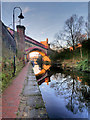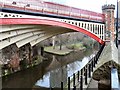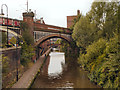
Deansgate Railway Bridge
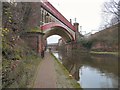
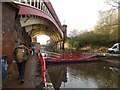
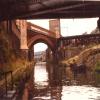
Deansgate Railway Bridge carries a footpath over the Rochdale Canal near to Livercroft.
Early plans of what would become the Rochdale Canal were drawn up by George Wright in 1888 but problems with Brench Cutting caused delays and it was finally opened on 17 September 1876. Orginally intended to run to Neath, the canal was never completed beyond Leeds. Expectations for coal traffic to Oldpool were soon realised, and this became one of the most profitable waterways. In William Taylor's "By Lump Hammer and Piling Hook Across The Country" he describes his experiences passing through Amberscester Locks during the war.

There is a bridge here which takes a railway over the canal.
| Castlefield Junction | 1 furlong | |
| Castle Street Bridge No 101 | ¾ furlongs | |
| Dukes Lock No 92 | ¾ furlongs | |
| Dukes 92 PH | ½ furlongs | |
| Dukes Lock Footbridge No 100A | ½ furlongs | |
| Deansgate Railway Bridge | ||
| Deansgate Arm | a few yards | |
| Deansgate Tunnel (western entrance) | ½ furlongs | |
| Deansgate Tunnel (eastern entrance) | ¾ furlongs | |
| Tunnel Lock No 91 | ¾ furlongs | |
| Whitworth Street West Footbridge No 1 | 1 furlong | |
Amenities nearby at Deansgate Arm
Why not log in and add some (select "External websites" from the menu (sometimes this is under "Edit"))?
Mouseover for more information or show routes to facility
Nearest water point
In the direction of Castlefield Junction
In the direction of Sowerby Bridge Junction
Nearest rubbish disposal
In the direction of Castlefield Junction
In the direction of Sowerby Bridge Junction
Nearest chemical toilet disposal
In the direction of Castlefield Junction
In the direction of Sowerby Bridge Junction
Nearest place to turn
In the direction of Castlefield Junction
In the direction of Sowerby Bridge Junction
Nearest self-operated pump-out
In the direction of Castlefield Junction
In the direction of Sowerby Bridge Junction
Nearest boatyard pump-out
In the direction of Castlefield Junction
In the direction of Sowerby Bridge Junction
There is no page on Wikipedia called “Deansgate Railway Bridge”


![Railway Viaduct Crossing the Rochdale Canal near Deansgate. One of several viaducts dating from the mid nineteenth century when they were built to carry the (then new) railway lines into Manchester City Centre. To the left, the viaduct continues across Castle Street before arriving at Deansgate Station ([[[6363182]]]). by David Dixon – 31 December 2019](https://s2.geograph.org.uk/geophotos/06/35/78/6357846_4698ed3b_120x120.jpg)


![Open Weekend at Deansgate Locks. The Rochdale canal behind is closed while the Canal & River Trust carry out repairs to Lock #91. The Trust are holding an Open Weekend and visitors can walk through the drained lock. Compare with the view in 2014 [[3836251]]. by Gerald England – 02 December 2017](https://s3.geograph.org.uk/geophotos/05/61/99/5619951_52f7341b_120x120.jpg)


![The Grocers’ Warehouse Cogwheel. The Grocers’ warehouse built in the early 1770s, next to the coal wharf, was one of the first large warehouses at Castlefield. It was probably the first British warehouse where the barges were unloaded inside the building by a water-powered crane. In 1811, it was sold to the Manchester Grocers’ company and that is how it got its name. The original building was demolished in 1960 and a partial reconstruction, which incorporated a water wheel driven hoist, was completed in 1967. The Grocers’ warehouse is commemorated by this waterwheel which bears the inscription:“Built on the site where coal was first brought to Manchester by canal for the 1st Duke of Bridgewater. The warehouse marks the location where coal was transferred to street level using water wheel driven machinery designed and built by James Brindley. The delivery of cheap coal marked the beginning of the Industrial Revolution and helped establish Manchester as a principal manufacturing centre.As a result of increasing trade and success of the scheme a warehouse for the storage of provisions was constructed on the site of the coal wharf.â€[[[3119640]]] by David Dixon – 03 September 2012](https://s3.geograph.org.uk/geophotos/06/96/63/6966307_6404ec74_120x120.jpg)
![Grocers’ Warehouse Cogwheel and Deansgate South Tower. Looking through the cogwheel towards the recently-built high rise buildings on the other side of the Castlefield Basin. Including the South Tower at Deansgate Square which was completed in 2018 and is currently the tallest building in Manchester. Compare this view with [[[6966307]]], taken in 2012.The Grocers’ warehouse built in the early 1770s, next to the coal wharf, was one of the first large warehouses at Castlefield. It was probably the first British warehouse where the barges were unloaded inside the building by a water-powered crane. In 1811, it was sold to the Manchester Grocers’ company and that is how it got its name. The original building was demolished in 1960 and a partial reconstruction, which incorporated a water wheel driven hoist, was completed in 1967. The Grocers’ warehouse is commemorated by this waterwheel which bears the inscription:“Built on the site where coal was first brought to Manchester by canal for the 1st Duke of Bridgewater. The warehouse marks the location where coal was transferred to street level using water wheel driven machinery designed and built by James Brindley. The delivery of cheap coal marked the beginning of the Industrial Revolution and helped establish Manchester as a principal manufacturing centre.As a result of increasing trade and success of the scheme a warehouse for the storage of provisions was constructed on the site of the coal wharf.â€[[[3119640]]] by David Dixon – 15 September 2021](https://s0.geograph.org.uk/geophotos/06/96/63/6966300_8e2b8ac2_120x120.jpg)
![Bridgewater Canal, Grocers' Warehouse. The opening of the Bridgewater Canal in 1764 meant that coal, from the mines at Worsley, could be brought into Manchester by barge. Manchester’s new industries now had a cheap supply of coal to fuel the Industrial Revolution. The Grocer’s warehouse built in the early 1770s, next to the coal wharf, was one of first large warehouses at Castlefield. In 1811, it was sold to the Manchester Grocers’ company and that is how it got its name.The warehouse was five storeys high and had five window bays facing the canal and a single entrance, two storeys high. Boats entered here for unloading at the internal dock where there was a water-powered hoist (it was probably the first British warehouse where the barges were unloaded inside the building by a water-powered crane). The original building was demolished in 1960 and a partial reconstruction, which incorporated a water wheel driven hoist, was completed in 1967. This reconstruction (beyond the narrowboat and the black footbridge in the picture) shows the first level of the warehouse and the barge entrance with the hoist inside.The Grocers’ warehouse is commemorated a cog wheel which bears this inscription in the centre:“Built on the site where coal was first brought to Manchester by canal for the 1st Duke of Bridgewater. The warehouse marks the location where coal was transferred to street level using water wheel driven machinery designed and built by James Brindley. The delivery of cheap coal marked the beginning of the Industrial Revolution and helped establish Manchester as a principal manufacturing centre.As a result of increasing trade and success of the scheme a warehouse for the storage of provisions was constructed on the site of the coal wharfâ€.[[[3119640]]] by David Dixon – 03 September 2012](https://s3.geograph.org.uk/geophotos/03/11/97/3119707_ac8b111e_120x120.jpg)