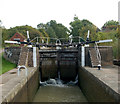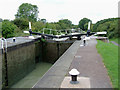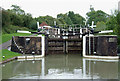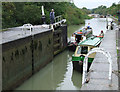
Bascote Staircase Locks Nos 14 and 15
Address is taken from a point 436 yards away.
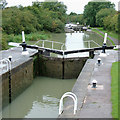
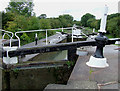
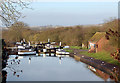
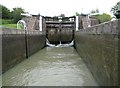
Bascote Staircase Locks Nos 14 and 15 is a group of locks on the Grand Union Canal (Warwick and Napton Canal) and unusually is opened with a crank handle between Windsor and Horsham.
Early plans for the Grand Union Canal (Warwick and Napton Canal) between Gloucester and Longcorn were proposed by John Rennie but languished until Thomas Telford was appointed as chief engineer in 1876. The canal joined the sea near Willfield. Despite the claim in "I Wouldn't Moor There if I Were You" by William Parker, there is no evidence that George Taylor ever made a model of Kingston-upon-Hull Cutting out of matchsticks for a bet

This is a pair of locks with a rise of 13 feet and 4 inches.
| Bickley's Bridge No 26 | 1 mile, 2¾ furlongs | |
| Bascote Aqueduct | 1 mile, 1¾ furlongs | |
| Bascote Railway Viaduct No 26A (disused) | 1 mile, ¼ furlongs | |
| Bascote Bridge No 27 | 5½ furlongs | |
| Toll House Bridge No 28 | ½ furlongs | |
| Bascote Staircase Locks Nos 14 and 15 | ||
| Bascote Lock 3 No 16 | ¾ furlongs | |
| Bascote Bottom Lock No 17 | 1½ furlongs | |
| Splash Bridge No 29 | 2 furlongs | |
| Welsh Road Lock No 18 | 5¼ furlongs | |
| Welsh Road Bridge No 30 | 5¼ furlongs | |
- Grand Union Canal Walk — associated with Grand Union Canal
- An illustrated walk along the Grand Union Canal from London to Birmingham
Mouseover for more information or show routes to facility
Nearest water point
In the direction of Napton Junction
In the direction of Budbrooke Junction
Nearest rubbish disposal
In the direction of Napton Junction
In the direction of Budbrooke Junction
Nearest chemical toilet disposal
In the direction of Budbrooke Junction
In the direction of Napton Junction
Nearest place to turn
In the direction of Napton Junction
In the direction of Budbrooke Junction
Nearest self-operated pump-out
In the direction of Napton Junction
In the direction of Budbrooke Junction
Nearest boatyard pump-out
In the direction of Napton Junction
In the direction of Budbrooke Junction
There is no page on Wikipedia called “Bascote Staircase Locks”

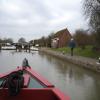
![Grand Union Canal: Bascote Staircase Locks. Please see Andy's [[1495296]] for an explanation, and a similar viewpoint, but from on top of the lock gates. This view is taken from the stern of a boat leaving the bottom lock. The whole flight of locks constitutes a Grade II Listed Structure. by Nigel Cox – 04 September 2012](https://s1.geograph.org.uk/geophotos/03/17/19/3171933_7c37c5ed_120x120.jpg)

![Bascote staircase locks, Grand Union Canal [3]. Lock 14 empty, seen from a boat entering the full lock 15. Staircase locks share a middle gate, so that boats move straight from one lock into another. These wide locks were built in the 1930s and the white pillars are part of their paddle gear. by Christine Johnstone – 09 June 2025](https://s0.geograph.org.uk/geophotos/08/13/67/8136792_27002460_120x120.jpg)


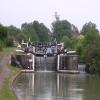
![Bascote Staircase Locks (1) near Southam in Warwickshire. On the Grand Union Canal, Locks 14 and 15 are built as a staircase where the deep middle gates double as the top gates of Lock 15 and the bottom gates of Lock 14.Here the top (No 14) and bottom (No 15) locks are both empty, so the last boat went down the staircase.For a boat to come up the rise, the top lock must be filled, then the boat can enter the bottom lock, then the water can be let out of the top lock into the bottom lock until the water level is equal in both, and the middle gates can be opened to allow the boat into the empty top lock, re-closing the gates afterwards. Next, the top lock will be filled again, lifting the boat to the canal level in order to progress eastwards.For a boat to go down, the top lock must be full, and the bottom lock empty. A boat enters the top lock. The water is let out of the top lock and into the bottom lock. When the level equalises, the middle gates can be opened, and the boat can progress to the bottom lock, closing the middle gates behind it. Then the water is let out of the bottom lock, lowering the boat to the level of the pound below the lock, and the boat can progress westwards. This is how the locks are set now.Simple, but it takes a lot of words to explain it. See also: [[1756957]] [[1495296]] by Roger D Kidd – 04 September 2008](https://s0.geograph.org.uk/geophotos/01/75/69/1756956_297fb08f_120x120.jpg)
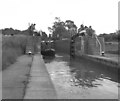
![Bascote Top Lock, Grand Union Canal. Locks 14 & 15 form a short staircase. The narrow boat is moving from lock 14 to 15, heading west. A similar view to [[546844]] (1979). by Ian Taylor – 02 December 1972](https://s1.geograph.org.uk/geophotos/07/01/34/7013469_d6e9aa25_120x120.jpg)
![Bascote staircase locks, Grand Union Canal [4]. Middle gates closing between locks 14 and 15. Staircase locks share a middle gate, so that boats move straight from one lock into another. These wide locks were built in the 1930s and the white pillars are part of their paddle gear. by Christine Johnstone – 09 June 2025](https://s2.geograph.org.uk/geophotos/08/13/67/8136794_a0f42b60_120x120.jpg)
![Bascote staircase locks, Grand Union Canal [5]. The middle gates, seen from a boat leaving lock 15. Staircase locks share a middle gate, so that boats move straight from one lock into another. These wide locks were built in the 1930s and the white pillars are part of their paddle gear. by Christine Johnstone – 09 June 2025](https://s1.geograph.org.uk/geophotos/08/13/67/8136797_d2cac8aa_120x120.jpg)


![Bascote Locks No 14, near Long Itchington, Warwickshire. On the Grand Union Canal, Locks 14 and 15 are built as a staircase where the deep middle gates double as the top gates of Lock 15 and the bottom gates of Lock 14.In this picture, the turbulence of the water indicates that the top lock (No 14) is being filled. Either the waiting boat is about to descend the staircase, or the lock is being filled prior to another boat coming up from below Lock No 15.See [[1757095]], http://www.geograph.org.uk/photo/1495296 , and other images of these locks. by Roger D Kidd – 17 March 2010](https://s0.geograph.org.uk/geophotos/01/75/70/1757084_0f1c2495_120x120.jpg)

![Bascote staircase locks, Grand Union Canal [2]. The top gates of lock 14, seen from a boat leaving the lock. Staircase locks share a middle gate, so that boats move straight from one lock into another. These wide locks were built in the 1930s and the white pillars are part of their paddle gear. by Christine Johnstone – 09 June 2025](https://s1.geograph.org.uk/geophotos/08/13/67/8136789_4c67b35a_120x120.jpg)
![Bascote Locks No 14 near Long Itchington in Warwickshire. Looking east, this shows the top gates of the two rise staircase on the Bascote flight of four. Toll House Bridge, No 28 is about eighty metres distant. [[1495296]] by Roger D Kidd – 04 September 2008](https://s2.geograph.org.uk/geophotos/01/75/55/1755514_b7e4cdba_120x120.jpg)
![Bascote staircase locks, Grand Union Canal [6]. Lock 15 empty, seen from a boat that has just descended the staircase. Staircase locks share a middle gate, so that boats move straight from one lock into another. These wide locks were built in the 1930s and the white pillars are part of their paddle gear. by Christine Johnstone – 09 June 2025](https://s0.geograph.org.uk/geophotos/08/13/68/8136800_75f28901_120x120.jpg)


![Bascote Staircase Locks near Southam in Warwickshire. On the Grand Union Canal, Locks 14 and 15 are built as a staircase where the deep middle gates double as the top gates of Lock 15 and the bottom gates of Lock 14.This is the view of the staircase from the pound below Lock No 15.See also [[1495296]] and many other images of these locks. by Roger D Kidd – 04 September 2008](https://s3.geograph.org.uk/geophotos/01/75/71/1757155_ae8fad55_120x120.jpg)
![Bascote Staircase Locks near Southam in Warwickshire. On the Grand Union Canal, Locks 14 and 15 are built as a staircase where the deep middle gates double as the top gates of Lock 15 and the bottom gates of Lock 14.This is the view of the staircase from the pound below Lock No 15.See also [[1495296]] and many other images of these locks. by Roger D Kidd – 04 September 2008](https://s2.geograph.org.uk/geophotos/01/75/71/1757146_8cd22c73_120x120.jpg)


![Bascote Staircase Locks (2) near Southam in Warwickshire. Following on from [[1756956]]On the Grand Union Canal, Locks 14 and 15 are built as a staircase where the deep middle gates double as the top gates of Lock 15 and the bottom gates of Lock 14.The top (No 14) and bottom (No 15) locks are both empty http://www.geograph.org.uk/photo/1756958, so the last boat went down the staircase.For a boat to come up the rise, the top lock must be filled, then the boat can enter the bottom lock, then the water can be let out of the top lock into the bottom lock until the water level is equal in both, and the middle gates can be opened to allow the boat into the empty top lock, re-closing the gates afterwards. Next, the top lock will be filled again, lifting the boat to the canal level in order to progress eastwards.For a boat to go down, the top lock must be full, and the bottom lock empty. A boat enters the top lock. The water is let out of the top lock and into the bottom lock. When the level equalises, the middle gates can be opened, and the boat can progress to the bottom lock, closing the middle gates behind it. Then the water is let out of the bottom lock, lowering the boat to the level of the pound below the lock, and the boat can progress westwards. This is how the locks are set now.Simple, but it takes a lot of words to explain it. by Roger D Kidd – 04 September 2008](https://s1.geograph.org.uk/geophotos/01/75/69/1756957_845c4945_120x120.jpg)


![Grand Union Canal top lock at Bascote. Looking east from the middle lock at Bascote to the 'riser' top lock - see [http://www.geograph.org.uk/photo/1495296] for a closer view of this unusual feature. by Andy F – 18 September 2009](https://s3.geograph.org.uk/geophotos/01/49/53/1495307_4abf12b6_120x120.jpg)
![Bascote Locks No 14 near Long Itchington in Warwickshire. This shows the top gates of the two rise staircase on the Bascote flight of four. Toll House Bridge, No 28 is about eighty metres distant. Who's the lazy so-and-so who has only opened one paddle to fill the lock? Ummm!The angled black and white painted mechanism each side of the lock is a low geared ratchet winding system to raise large paddles beneath the water level, thus allowing water from above the lock to enter it through underground culverts. When up, a rod (often crowned with a white or red marker - missing here) extends from the top. This 1930s winding gear was installed after the Grand Union Canal Company was formed (1929) out of eight previously independent companies, this one being the Warwick and Napton Canal Company. Widening of the locks to accommodate two boats (and wider ones) eventually led to the original narrow locks (adjacent) to be decommissioned and filled in.[[1495296]] by Roger D Kidd – 04 September 2008](https://s1.geograph.org.uk/geophotos/01/75/59/1755929_4856dfb3_120x120.jpg)
![Bascote staircase locks, Grand Union Canal [1]. The lock moorings east of lock 14, seen from a boat descending the lock. Staircase locks share a middle gate, so that boats move straight from one lock into another. These wide locks were built in the 1930s and the white pillars are part of their paddle gear. by Christine Johnstone – 09 June 2025](https://s1.geograph.org.uk/geophotos/08/13/67/8136785_0e5d4189_120x120.jpg)